This is our first guest article written by Haki (profile here), edited by Ardens.
When viewers discuss Spy x Family, one of the most popular and highly regarded series of recent years, it’s easy to focus on the obvious themes: pretending and wearing masks, the Cold War — or war in general — family, or loneliness.
The foundation of both the manga and anime is espionage. Loid, the main character, is a man whose real name we don’t know and which he himself abandoned in order to serve as a spy. It is therefore no surprise that another major theme of the story is living a double life. Every well-developed character has something they hide, something that forms the core of their story and personality.
All of this works well as comedy, but becomes tragic when we stop to think about it.

The “Thesis”
I would propose the following thesis: Spy × Family is a story about people who cannot believe that they can be loved and accepted for who they truly are.
- That is why they lead double lives—to live within a substitute for safety.
- That is also why they constantly create alternative versions of reality inside their own heads.
Perhaps this is a less obvious element of the series, yet it’s the one I reflect on the most. Every well-developed character carries on, at times astonishingly elaborate, monologues within their own mind, which most often result in absurd interpretations of reality and unnecessary actions.
First, I want to focus on two things that distinguish us the most from other animals and which, for most of us, are also the greatest challenge: feelings and thoughts.
For a spy, feelings are generally an obstacle. Both the more surface-level and temporary signals: a sense of joy, exhaustion, irritation, or sadness; but also, and even worse, the larger emotions, those that go beyond bodily reactions and reach the higher dimensions of human existence: attachment, trust, regret, and guilt.
These can do more than simply interfere in a tense situation—they can destroy an entire spy’s identity. In one brief scene from the second half of the first season, we see Nightfall being trained by Twilight, who tells her directly: “Kill any emotion.” And she, of course, interprets this so literally that she diligently tries to maintain a poker face 24/7!
Feelings can still be useful insofar as they function as a “pure” signal, much like pain. Uncertainty, fear, or irritation can be helpful even in tense situations if they are examined: Why am I afraid? Does someone seem suspicious? Et cetera. It’s here that thoughts enter the picture. They’re crucial! Almost as they were in prehistory, thoughts help us protect ourselves from predators, create survival plans, and prevent possible accidents. In this area, the main protagonist, Loid, is exceptionally active, and that’s one reason he has remained so effective — and alive — as an agent.
Over-thinking and analysis are essential both for individual missions (such as the jewel theft operation shown in the second episode) and for his overall functioning, and therefore for the broader mission as well (such as the long-term Operation Strix).
However…

For some people, like Descartes, thinking appears to be the pinnacle of human ability (hence “I think, therefore I am.” ) I suspect that many of us in this age — perhaps all of us — feel that the form has begun to outweigh the substance. The term “overthinking” has become popular, yet it doesn’t refer to truly analytical thought.
Rumination, repeating catastrophic scenarios, or on the opposite side of the spectrum affirmations and logotherapy are all activities connected with thought that either destroy a person or make them stronger. Some people today even reject thinking as the supposed peak of humanity, seeing beauty in nature and wanting simply to be before they think, let alone act. Oh, those are fascinating subjects too, but they drift away from the main topic!
Case Study: Anya Forger
Thinking is necessary for the characters, but all too often it seems more like a curse than a strength. Until now I’ve spoken mostly about Twilight, but perhaps the best example to begin with would be Anya. Not only is she a child, lacking knowledge, life experience, and mental maturity, but she’s also an esper. This “Little Forger” is an exceptional case from every possible angle.
Not only can she create her own catastrophic scenarios, but because she can read minds, she does not merely hear the truth about another person, she hears that person’s catastrophic scenarios as well, and can very easily mistake them for reality. It is an explosive combination.
Take, for example, the absurd situation in which she quickly concludes that she is capable of carrying out “Plan B”: becoming friends with Damian.
If she gets a dog and talks with him about dogs, then simply starting a conversation about pets already seems like a strategy that is 90% guaranteed to succeed, leading to an invitation to meet his father, meaning Operation Strix is basically complete! But this way of thinking can go even further and turn Yor into her rival. Because if Yor becomes friends with Damian’s mother and Loid gains access to Donovan through that relationship—which would be Plan C—then Anya’s Plan A and Plan B become unnecessary, meaning she can be sent back to the orphanage!
Now, we can laugh at that.
But do we not recognize something of ourselves in it?
Certainly, from a distance such conclusions appear absurd from the start, but when those scenarios are unfolding inside my own head, and I am the one potentially threatened by them, do reason and moderation not become weaker?
A Christian Connection
An interesting example of “Anya-style thinking” in Christian literature can be found in a passage from Teresa of Jesus’ The Book of [Her] Foundations. Unfortunately, I do not remember which contemporary author it was (perhaps Javier Sancho Fermín?), but he devoted one chapter of his book to the problem of anxiety and overthinking, using precisely this example: Chapter 3 and the foundation in Medina del Campo.
St. Teresa has just opened a new convent. The chapel has been consecrated, the first Mass has been celebrated, and the tabernacle is already in place. It’s a day of joy. Yet after the celebrations, she carefully examines the surroundings. The foundress has established the chapel in a very poor location, poorly maintained and requiring significant work before it can become fully functional.

Thanks to her vivid and emotional style of writing, we’re able to follow the entire process of her catastrophizing. We begin with celebration.
Then we move into concerns about the appearance of the place.
Questions arise: Was it right to place the Eucharist here already? Is this a worthy place for the Living God? Then come concerns about safety.
St. Teresa quickly turns her thoughts toward reports arriving from Germany and France—stories of militant Protestant groups breaking into churches and desecrating the Blessed Sacrament. Although no such reports existed concerning Spain (and, if I understand the historical context correctly, such actions never truly spread to the Iberian Peninsula), her vivid imagination already sees groups of people attacking the Tabernacle.
Within her own mind, Teresa has already become guilty of sacrilege by failing to provide adequate protection against vandals. Well… there goes any sleep that night. Hello, enormous tension and stress. Stress over something that never happened and, as we know from history, never happened in that convent either. But hey—in her mind it already took place! And actions followed: From that moment onward, Teresa organized guards who protected the chapel even during the night against a possible attack.

But returning to Spy × Family.
Anya is a perfect example, yet this kind of catastrophizing/over-thinking happens within every character. And these dark thoughts seem so difficult to control precisely because of disordered emotions.
Yor Forger is most often portrayed as overanalyzing whenever the possibility of a romance between Loid and Nightfall arises—whom she knows as Fiona. She wonders: Am I enough as a wife and mother? Is that why he is looking for someone else? And like someone aware of her weaknesses, she notices her shortcomings and continues down that path of thought. Could she change something about herself so that he would stay?
But thinking rarely remains on a single track. Sometimes we move to a meta-level and ask, as Yor does: “Wait, but we are only pretending to be married. Doesn’t he have the right to find true happiness in a real relationship?”
Such a thought may provide temporary relief. But then it can lead to even greater pain: Why do our lives look the way they do? Perhaps this farce should come to an end? And so she finds herself one step away from apologizing and asking for a divorce. This theme could be found both in the first season and the movie. And other worries are no less important: Being exposed. Being arrested. Being executed.
Back to Twilight:
Of course, he is a master at creating dozens (hundreds?) of different scenarios from a single sentence. As we said before, it, unfortunately, comes with the job. And Yuri is capable of overthinking as well.
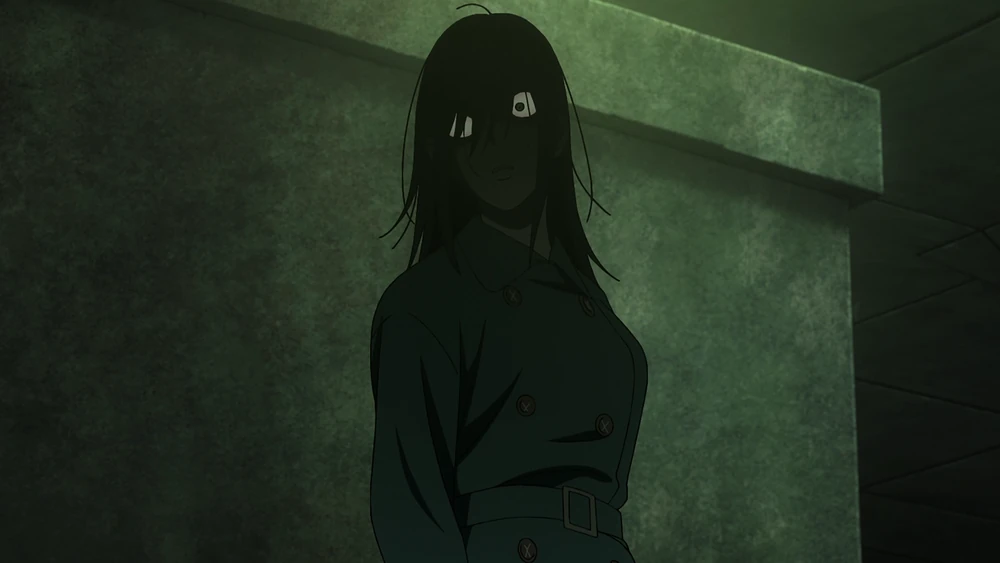
Nightfall may be the most interesting example because the contrast between the persona she presents — even among her fellow WISE agents— and the emotions she actually experiences is perhaps the greatest in the entire series. And only Anya, as an esper, truly knows the scale of that contrast.

In Nightfall’s case, her thoughts tend to create idealized scenarios in which impressing Twilight eventually allows her to become Mrs. Forger in Yor’s place. Though perhaps even more interesting is the mask she chooses to wear. Because the contrast between the excited girl whose crush and role model has praised her and the cold, powerful agent she presents to the world reveals two extreme personalities.
It is genuinely sad to see how a role she imposed upon herself (and one that was never actually required by the organization) diminishes an entire person who might otherwise be capable of genuine joy and appreciation of life’s smaller moments. And, in a sense, it makes her a tragic character.
Moving toward a conclusion:
Perhaps the greatest enemies of the characters in Spy × Family are not politicians, assassins, or corrupt military institutions, but the voices inside their own heads.
The voice that constantly says: “Everything is about to fall apart.”
“No one will ever love you.” “You must control every situation.”
And that voice becomes more than a source of comedy. It creates a second identity—or conceals part of the real one. And that concealment can even be beautifully motivated by concern for another person. After all, both Yor and Yuri deceive one another in order to protect each other. So thinking is beautiful and good… but only in moderation.
Spy × Family reminds us that not every thought deserves our trust. And not every thought is worth following. And perhaps also this: I am not my thoughts.
Oh, since we have been discussing a genuine esper in the form of Anya, let us close with this: Sometimes the greatest difference between loneliness and closeness is whether we listen to the real person standing beside us, or to the voice that has been living inside our head for far too long.
~Haki
St. Justin Martyr, pray for us!


Leave a Reply