I place this work in Mary’s hand to bring to Jesus our Lord.
Revelation 12:1 “And a great sign appeared in heaven: a woman clothed with the sun, with the moon under her feet, and on her head a crown of twelve stars.”
First, background
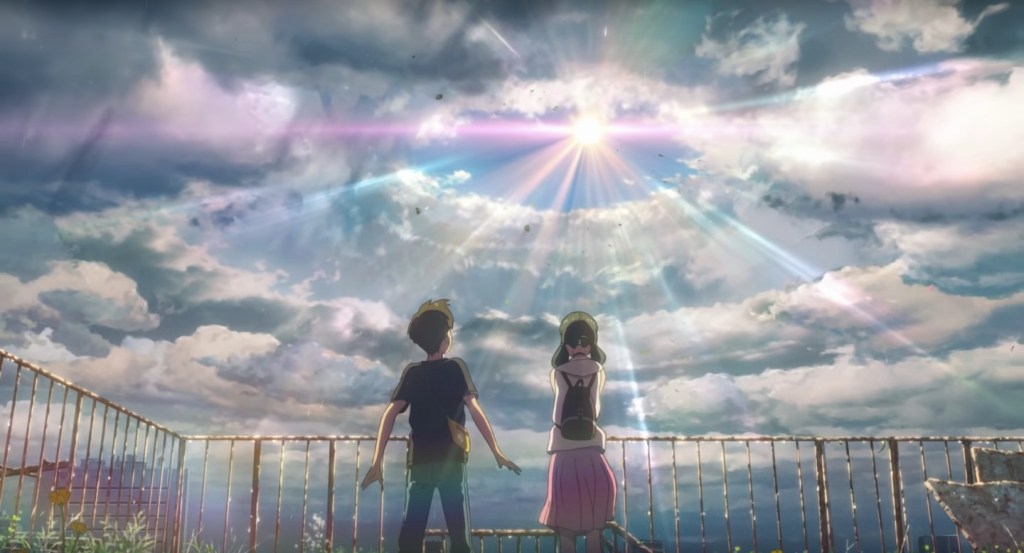
Weathering with You is a 2019 anime film by Shinkai Makoto – who you’ll recall from our Suzume article. Shinkai’s taste for blending a regular boy meets girl story into one with supernatural & worldwide consequences is again on full display here.
Second, here’s the story in 5 sentences
Our story follows runaway student Hodaka working in Tokyo for an amateur magazine company. Tokyo has been having unusually rainy weather and Hodaka’s company bites at the story of it being a supernatural problem. The solution everyone is talking about is a “sunshine maiden” – a girl who can control the weather. Hodaka meets such a girl, Hina, and the two go around Tokyo warding of the rain. However, we soon find out that clearing up the skies is slowing killing Hina and she must either sacrifice herself completely to restore the original climate, or watch whole parts of Tokyo be lost to higher water levels.
Third, our focus here
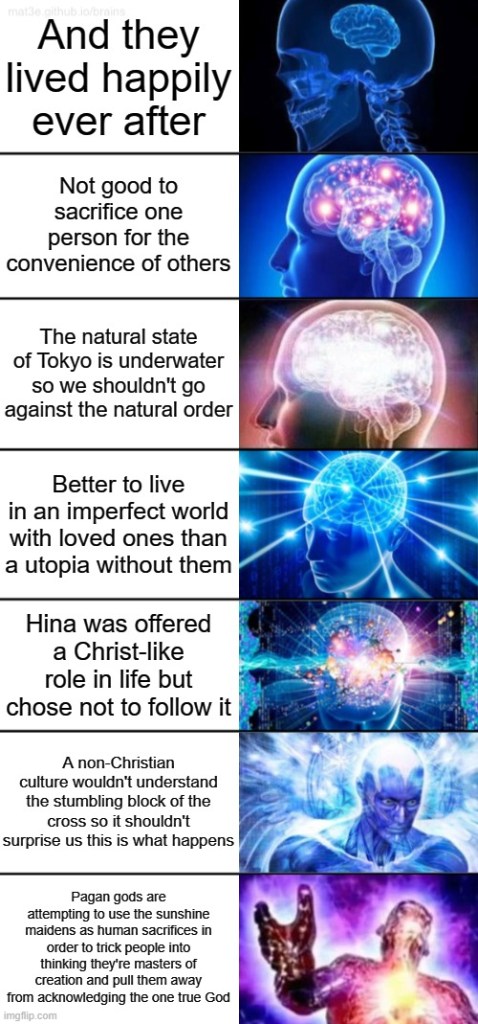
What I like about Weathering with you are its layers of interpretation. On a personal level we can talk about if it’s better to leave a loved one to serve the country or instead if each person also has the right to live out their days with their family. But on a supernatural level, I think it has even more to offer. This comes from a simple question: what is the natural state of Japan? We learn that for centuries sunshine maidens have been sacrificed to hold back the rains, but is this really mankind being virtuous or simply selfish? Perhaps the sunshine maidens aren’t sacrificed to save the people’s lives but merely for their convenience? Once this dilemma is put forth, it can’t be ignored. Finally, Hina’s and Hodaka’s choice is seen as good or imperfect depending on how we view the background dilemma of Tokyo’s natural state.
Fourth, what’s the point?
Precisely that more than one way of interpreting the story’s conflict doesn’t rule out other interpretations. Can we view Hina’s opportunity to sacrifice herself to save the people of Japan as Christ-like? Sure. Could we also view it as humans trying to change nature rather than oversee and work with it? Of course. The two aren’t necessarily mutually exclusive. Don’t get me wrong, I’m not saying everything is a free-for-all and there is no inherent or objective meaning. What I am saying is that affirming one sense of the story doesn’t mean that is the exclusive sense of the story.
If this is true for simple man-made fiction, how much more for the Bible, which contains the inspired Word of God? Many disagreements in Christianity happen because people interpret passages of the Bible in an exclusive sense. As Catholics we have a rich tradition of reading Scripture in a literal, allegorical, moral, and anagogical way (check out Catechism paragraphs 115-118). For example, the Israelites literally crossed the red sea to escape slavery in Egypt, but allegorically this prefigures Christ leading us out of slavery to sin. Morally, this leads us to no longer live as we used to; and anagogically we now keep our eyes focused on heaven our eternal home.
Other common examples include the opening quote of this article from Rev 12:1 or St. Peter’s confession from Matthew’s Gospel (Mt 16:18). Does the woman in Revelation signify the Church or specifically the Virgin Mary? Affirming one of these doesn’t exclude the other. Similarly, in Matthew’s gospel is Jesus building His Church on Peter or on Peter’s confession? The answer: Both. The Catechism of the Catholic Church cites Mt16:18 not only in the section on the Papacy (n. 881) but also in the section on the confession of faith of the Christian people (n. 424). Our certainty that Peter was entrusted with leading his brother apostles is not put in danger by also seeing his confession as the foundation of Christian Faith.
Final take away
The full riches of Scripture are only revealed when we read with all 4 senses mentioned above. And because being a Christian affects every part of our life, we shouldn’t oversimplify information that comes to us by viewing it through one lens. We find the bible boring because it doesn’t seem to give the dynamic multilayered view that we expect from contemporary media. We search movies over and over for Easter eggs or talk about why one character is better than the rest. Why don’t we do this with Scripture? Why don’t we search the Gospels or Old Testament for details and cross references that most people don’t catch the first time through? Until we realize that the bible has infinitely more depth than any other work of history, until we search it with the same fervor, until we stop reading it with only one sense, we will always be an incomplete Christian.



 Anime Christi
Leave a reply to Made in Abyss: Dying to Self – Anime Christi Cancel reply