I entrust this work to Mary, our Mother, that she may make it acceptable to Our Lord Jesus Christ.
“Think of what is above, not what is on earth.” Colossians 3:2
First, the disclaimers:
- As of April 2020, Noragami is an ongoing series. I am not commenting on the whole series, but simply one aspect of its internal workings put forth by its authors Adachi, and Tokashiki.
- This is again a personal opinion, but I wouldn’t recommend the show to just anyone. It is considered a shonen title, yes, but some characters, scenarios, themes, and topics are more mature in nature. I hate to give hard and fast rules but if I was forced, I’d say at least be 16 or 17 years old.
Second, the boilerplate:
Norogami, takes places in present day japan and presents the gods of shintoism much like the greek and roman gods. They’re powerful beings who are for the most part immortal and help humans, but also do things like hold grudges, kill each other, cause general mischief and so on.
Throughout their daily duties, each god has one or more servant spirits that assist them in different ways. These spirits are called shinki, which roughly means a sacred treasure. While they usually just hang around looking like people, shinki take on various forms when being employed by their god; some are swords, others are a piece of armor, still others a whip, a lion, a pair of gloves, or an earring, etc.
Here’s a quick piece of information to keep in mind:
All shinki share two traits:
- They’re always human souls that have died accidently, and so still have a strong will to live,
- They must also be pure and not corrupted in any way.
Fascinating that the best or closest servants of divinity are not lesser gods but must be human, and pure.
Back to the boilerplate for two points
First a quick one: when serving their master, shinki can be pseudo-upgraded into what is called a “blessed” shinki. This only occurs when the shinki risks losing his life in service of his master.
The second one requires more detail: even though they are chosen from pure spirits, shinki are still able to sin, deceive and betray their master. Examples of this are straightforward and include stealing, lusting after a human, directly disobeying an order, and other things. When this happens it causes a sore, called blight, to appear on both the shinki and the god he serves.
One interesting point is that the shinki himself doesn’t feel pain from this blight, the god he serves does feel severe pain from the blight. If the shinki keeps sinning his and his god’s blight will continue to grow and cover the body, with the pain of the god’s blight obviously increasing in pain.

In order for a shinki and god to be cleaned from his blight, the shinki must undergo a purification ritual, called sometimes in the english translation an ablution. What happens is three other shinki must cast a boundary around the blighted shinki while he or she confesses all the things they have done which have caused the blight. If done correctly this cures both shinki and the god he serves; however, if the shinki refuses to repent they will be turned into a phantom and probably attack the other three shinki that made the boundary. This, coupled with the fact that the purification would take an hour or more, is why most shinki don’t want to step up for this task.
And with that we’re done… with the summary that is.
Now let’s get to the reason why people might read this.
First, let’s look at the shinki themselves:
Remember those two criteria I mentioned before? Regardless of the cause I find it fascinating that shinki need a strong will to live. There is no passivity in being a servant. One is made a servant in order to serve. “As the eyes of a servant look to the hand of his master… so our eyes are on the Lord our God.”(Ps 123)
I’d also like to point out as I hinted before that in the Christian worldview, it is human beings, not the angels, that are God’s sacred treasure (shinki?). One detail I didn’t bring up before was that each shinki when called into service is given a name by their god. This sense of a new identity is not foreign to the religious community. We see it multiple times throughout the bible with Abram, Jacob, Saul, and Simon Peter. But, what is more interesting is that the name that a god calls his shinki is written on the shinki itself. I could be stretching this too much but here goes. It is not the body, but the spirit that receives this marking much like the sacraments of baptism and confirmation purify, anoint, and welcome us into our Heavenly Father’s family. In fact the gods of Noragami often refer to the multitude of shikni they have as a clan and affix to each shinki’s name a syllable to show the unity of the clan. How much more for the LORD God, from whom “we have not received a spirit of slavery, but of sonship” (Rom 8:15) by which we cry Abba, Father! (Gal 4:7)
I think we can also get a better feel for what it means to say “My God, My God,” or “the LORD my God.” As Christians we often say Our Father. But we can sometimes emphasize the notion that it’s my, Tom’s, Jeff’s, and Bill’s father, which God is — don’t get me wrong. But, the primary fact is that Jesus Christ and I have the same Father.

For me at least, this sense of “my God” riles up my irascible will because it reminds me that we’re not working under some NGO for some broad national project. We’re working on the personal scale of human to human interactions. God became Man for this very reason. He offers salvation to all of humanity yes, but He does it on the personal level. The sacraments of Jesus instituted show us this deeply personal aspect.
I do not want to come across as defending this pagan work for more than what it is. But if we can see the heroic virtue in greek and roman pagan literature, I think when we see the virtue of religion in other works as well. The Virtue of Religion IS NOT a supernatural practice! Religion falls under the virtue of Justice and rendering to God the worship due to Him. (Summa Theologicae II-II Q.81)
Jumping back to the shinki briefly,
Remember the whole becoming a better shinki by risking your life for your master notion? Now I know some might say the “strike me down and I will become more powerful than you can possibly imagine” mentality can come from any pagan wisdom. But losing one’s life for God, and having it given back, seems to ring a distinctly christian sound (Mt 16:25), especially when it is done out of a personal love and total commitment.
We don’t die to ourself to become part of the eternal impersonal force. We die to gain eternal life by dying to ourselves but also for someone else. It is not just dying, it is sacrifice. Again this is on the personal level.
If I’ve held your attention this long I can finally get to what I originally wanted to write about.
Let’s take a look at Noragami’s “purification”
What initially piqued my curiosity was two fold.
First, it isn’t enough simply for a shinki to say sorry and plead forgiveness, rather the shinki must state all the sinful things he or she has done that incurred blight upon themselves and their god. This seems strangely familiar to Catholic ears that might recall “kind and number” (Cf. Can. 988 §1). We know that confession generally speaking is not necessarily a Christian notion, but the specific-ness seen here definitely appears to lean toward that understanding. (James 5:16)
What is unfortunately lacking in Noragami is a sense of penance beyond the usual “I’ll back it up to you by working harder” mentality. Although, part of me wonders if this could be covered by the painful process of the purification ritual. But there isn’t much detail to go on with that so perhaps we’ll leave it at that.
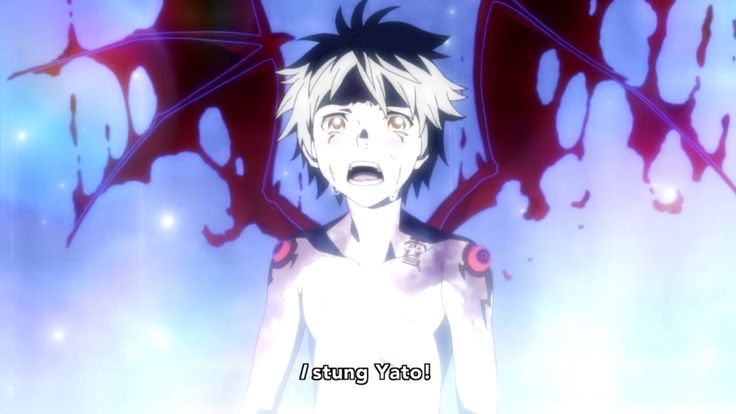
Second, the fact that if a shinki refuses to confess he or she will eventually be turned into a “phantom”, the Noragami equivalent to demons or ghouls, and will then have to be killed, seems quite drastic as well. Being a pure spirit and becoming a shinki does not guarantee a good life. Rather it is carried out in every action we do. Again, at least for me, I get quite the “Thy will, not my will be done” vibe from this. Or perhaps keeping with the servant imagery “non serviam” is brought to mind.
Another key point to bring up is that while we take for granted the reasons why sins such as these are morally wrong, the show explains that since a shinki no longer belongs to the human world, even though they were once human, it is disorder for them to seek human things, such as wealth, sexual pleasure, food and drink. Again I could be connecting things that have no relation but does this not sound like St. Peter’s exhortation: “like obedient children do not be conformed to the desires you previously had,” (1 Ptr 1:14 ) or St. Paul pleading to the Ephesians “you were taught to put away your former way of life, your old self, corrupt and deluded by its lusts, and be renewed in the spirit,” or his letter to the Romans “let us live honorably as in the day, not in reveling and drunkenness, not in debauchery and licentiousness, not in quarreling and jealousy. Instead, put on the Lord Jesus Christ, and make no provision for the flesh, to gratify its desires.” (Rom 13:13)
Obviously, Noragami is a work of fiction and not a theological presentation. Analogies break down. One obvious way would be that our sins don’t necessarily weaken God to the point of being bedridden as the show portrays the effects of blight on the shinto gods. God does not need us, and so we can never hurt him in this regard.
Nevertheless there is quite the devotion in Catholic Churches to do penance in reparations for the wounds the Jesus received during his passion and death, particularly His Sacred Heart that was pierced for us. The words St. Margaret Mary Alacoque received from our Lord come to mind.
“Behold the Heart that has loved men so much that It has spared nothing, even to exhausting and consuming Itself, in order to testify to them Its love. But in return I receive from the greater part of mankind only ingratitude, by reason of the contempt, irreverence, sacrilege, and coldness shown Me in this Sacrament of Love.”
In conclusion,
I’m glad you made it this far. If you haven’t picked up on it already, part of me has a certain miles Christi type spirituality sometimes and sometimes action shonen titles can stir up that militant spirit as they do most kids. I like to think this is me being child-like and not childish since the kingdom of heaven belongs to ones such as these (Mt 19:14), but I guess I could be wrong.
Jesus, make our hearts like thine.
St. Justin Martyr, pray for us.


 Anime Christi
Leave a comment