I put this work in the hands of Mary, our Mother, so that she may make it pleasing to Jesus Christ.
“Whatever is true, honorable, just, pure, lovely, gracious, if there is anything worthy of praise think of these things.” Philippians 4:8
What is this about?
Well, I wanted to write down:
- Why I think Demon Slayer does a good job of contrasting Good and Evil, as well as Justice and Mercy.
- Maybe show how Christianity can confirm but also go beyond some of the themes presented in the work.
P.S. This article is probably better understood if one has either seen the first season of the show or read the first 5 volumes of the manga.
First, disclaimers:
- Originally a manga, the animation studio Ufotable made what I believe is a beautiful anime adaptation. As of 2022 the anime adaptation is incomplete. The story does have some graphic depictions of violence even if they are animated. I’ve seen a 17+ rating for the anime and while not an absolute rule, I think it’s a good starting place.
- There will be of course plot spoilers in this commentary.
Now, the boilerplate (if you’ve seen the series skip this one):
Demon Slayer takes place in Taisho era Japan (i.e. A.D. 1912-1926). The premise is that there are powerful creatures called demons who eat humans. It may sound simple but that’s the beauty of it. These demons are only active at night as sunlight will disintegrate them. Demons possess super strength and rapid healing abilities for severe wounds. Some will have some type of magical power that becomes stronger the more humans they consume. Besides sunlight, demons can really only be killed by being decapitated with a Nichirin sword (a sword made out of a metal that has absorbed sunlight). I guess it’s still technically the sunlight that kills them. Pretty simple right?
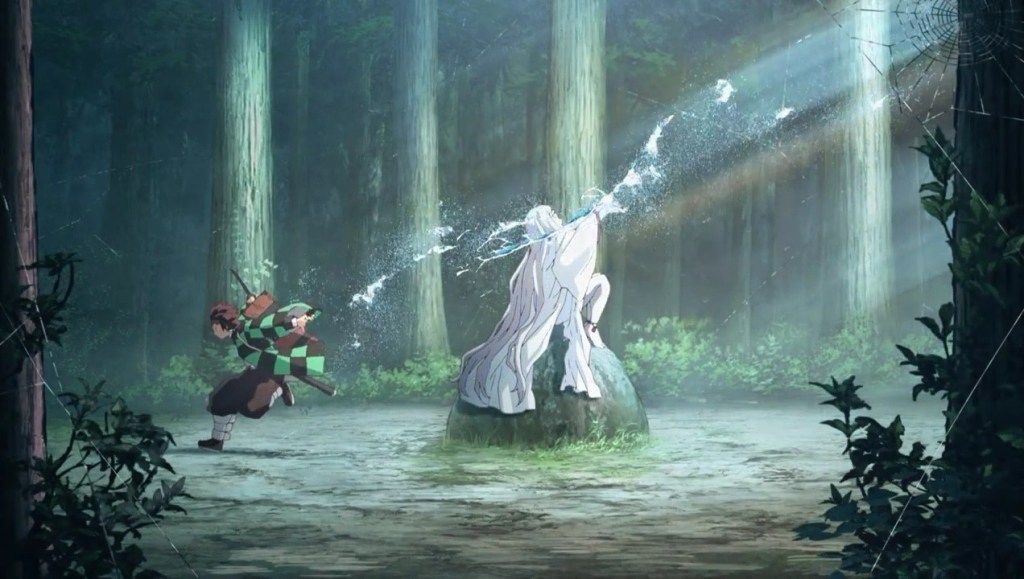
Pretty early on we learn that there is actually only one demon who is creating all the other demons. The root is traced back to a single source. Also early on, Tanjiro, our protagonist, finds his family murdered and his sister, Nezuko, transformed into a demon but here’s the catch: after initially attacking him she recognizes her brother and stops.
After muzzling his demon sister, Tanjiro sets out to join the Demon Slayer Corp. (pretty self explanatory) with two goals in mind.
- Find this original demon and kill him.
- Find a way to turn Nezuko back into a human.
As the story progresses it’s mentioned that Nezuko’s body may have changed to regain energy from sleeping instead of eating humans. As such she sleeps during the day and sometimes comes out at night to help Tanjiro with his demon slaying job. A cute sibling dynamic.
Third, now to the good stuff.
I think what makes Demon Slayer so easy to approach is its simple story. Many times it feels like anime shows have crazy spiraling plotlines that never end. (I’m looking at you DBZ, Naruto, One Piece, Bleach, etc…)
If we all enjoy a straightforward story, then what about Demon Slayer makes it so straightforward? I argue it is the strict dichotomy between good and evil that is portrayed throughout the show. I’m not sure where the idea “evil is always more complicated than we think” came from, but it’s a horrible one. Early on in the show, Tanjiro’s teacher, who understands Nezuko as an exception to demons, says that if she does ever kill anyone, Tanjiro must immediately kill her and then himself. Now I realize most of us can see the japanese honor code seeping through here but his mentor is making the point that right now she is in a quasi-demon state, if she should become a demon (i.e. by eating/attacking people) she is no longer your sister – kill her. We do not tolerate nor do we make exceptions for evil, we destroy it completely.
You might counter that since Nezuko was transformed into a demon why doesn’t Tanjiro or his teacher kill her now. You are raising a valid concern but I would respond that even though the disposition towards evil is within her it has not been carried out. Something the show points out in the fact she doesn’t eat or attack humans. We might say there is a concupiscence within her but it is not acted out in the will, it has been restrained (both physically and mentally).
To me, the clear presentation of good and evil is refreshing, especially if you’ve read a manga called Tokyo Ghoul, which is one that I actually wouldn’t recommend to anyone. Ghouls in that story are like the demons in Demon Slayer except they don’t die by sunlight, so they can do more human things. The protagonist of Tokyo Ghoul is made into a ghoul via surgery and instead of trying to become human again, the series progresses into a nebulous philosophy on the coexistence of humans and ghouls. The closest we get to this in Demon Slayer is a demon who used to be a doctor who has modified herself so that she only needs a little blood to survive. She also steps up to help Tanjiro find a cure to turn his sister back into a human presumably because she wants the same thing and not remain a demon forever!
Let’s talk about Justice and Mercy
And for this we need a little more story summary…
What I’ve said of Demon Slayer so far may have a “Joshua mowed down Amalek by the edge of his sword” or “Samuel hewed Agag to pieces before the Lord” type of vibe. And I know I said the strict division of humanity and demons is what I find refreshing but, the author (Koyoharu Gotōge) does a great job of contrasting Tanjiro’s hatred of evil with his overflowing love and charity. It gives off a sense of what I refer to as “Hating the sin, loving the sinner.”
During the Natagumo Mountain Arc there are two interactions I want to focus on.
- Tanjiro killing the mother spider demon
- Shinobu killing the sister spider demon
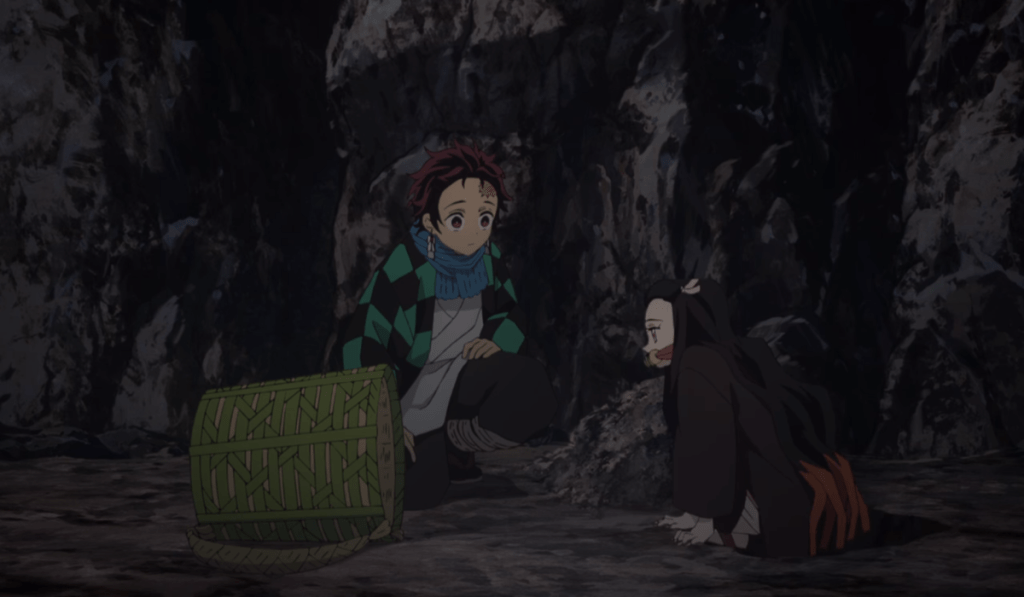
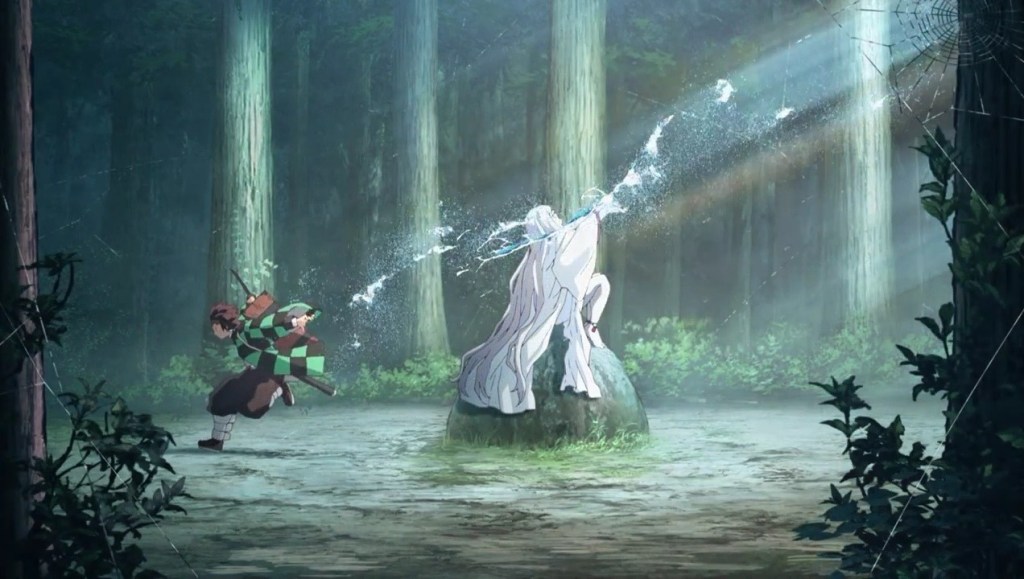
The first takes place in episode 16. The mother spider demon has killed numerous demon slayers. Upon seeing Tanjiro she realizes how much fear she lives in of Rui, the demon running the spider family, who himself kills any demon he is angry with. She thinks of trying to defend and kill Tanjiro but realizes that if she were to die she would be freed from her constant fear of death and abuse by Rui. What happens next is important:
- She lowers her defenses and surrenders to Tanjiro’s attack.
- Tanjiro sees this and switches his “Striking tide” attack to one called “Blessed rain after the drought” killing her painlessly.
Now it may seem obvious why people like this so much. It not only shows Tanjiro’s keen observation of details in the heat of battle and his ability to change forms mid strike, but it also shows his merciful side in choosing to deal out a painless death. But what can be overlooked here is that the spider demon still dies! Yes there is mercy, but no one – neither she nor Tanjiro – tries to make her crimes seem less than what they are.
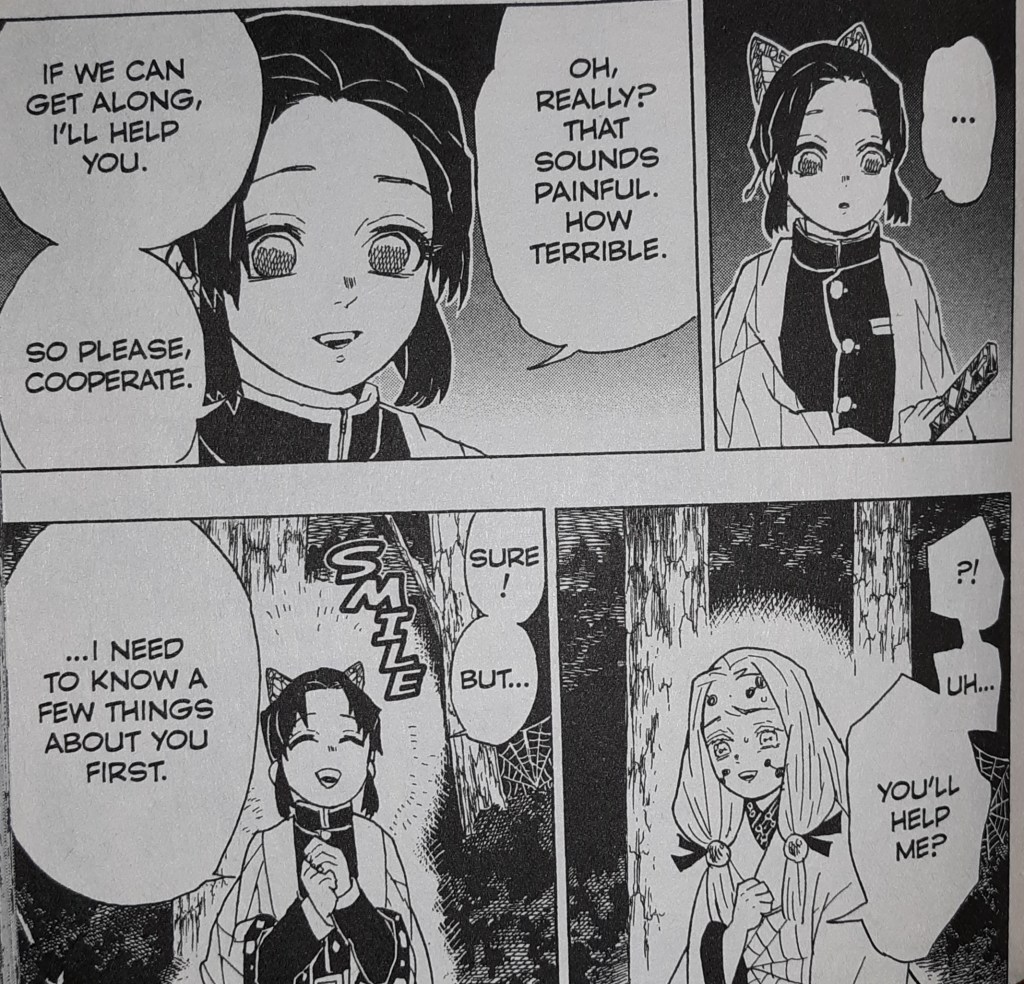
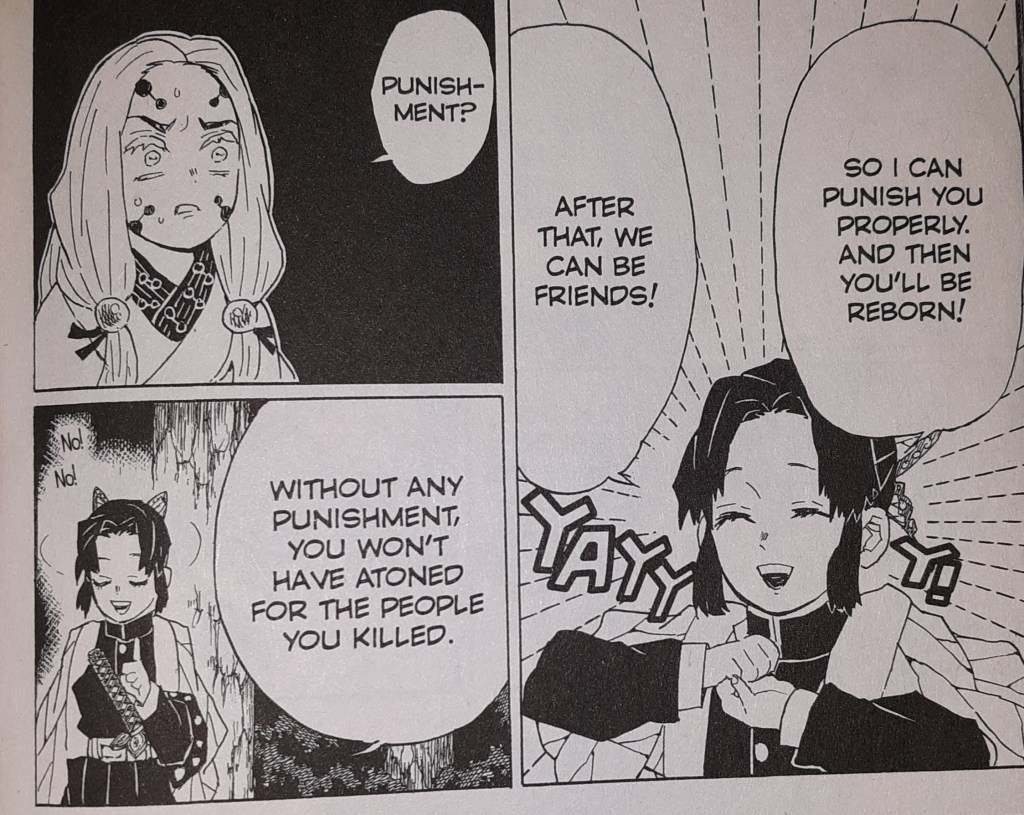
The second interaction takes place in episode 20 where Kocho Shinobu, a high ranking demon slayer, confronts the sister spider demon. Unlike Tanjiro’s scene, this one has a bit more dialogue so I’ll provide a summary below.
1.) Spider demon once captured, begs for mercy and says Rui forced her to kill people
2.) When asked how many she killed, she lies saying “5, but I was forced to”
3.) Shinobu says she saw 14 other cocoons on the western side of the mountain, and guesses the sister demon may have possibly killed 80 people
4.) Shinobu wants an accurate number so she’ll knows how severe a punishment to deal out (note: she isn’t planning to kill the demon, but only punish for sins)
5.) She says if the demon goes unpunished the murdered people will go without justice
6.) After she’s suffered her sins will be forgiven, since she’s a demon she won’t die either
7.) Demon rejects this & retalitates. Shinobu says “I can see we’ll never be friends”
8.) Shinobu kills her with venom instead of decapitation which may be more painful?
This drawn out conversation offers us more insight than Tanjiro’s encounter.. What we see here is a rejection of mercy because it comes packaged with justice. The demon is willing to admit she’s killed people but tries to pass it off as her being forced to. The old “I didn’t actually want to do those things.” There is a hope to get off easy because someone coerced her (so she claims). After being found out, she corrects the number to 14, but Shinobu again suggests this too is inaccurate. In order to be properly pardoned she needs to be punished for those she killed. Shinobu even mentions that since she’s a demon with regenerative powers she won’t die from this punishment and there won’t be any lasting sign either. There will be pain but the end will be better.
Perhaps this fills the demon with despair in that she is unable to foresee a good outcome among an arduous or painful path. It is also fair to say that some of the punishments Shinobu mentions are quite painful. Either way, she not only refuses but also retaliates. After realizing that the demon isn’t going to repent, Shinobu understands that the only thing she can do is kill her (subtitled dialogue from before “I can see we’ll never be friends”).
I thought this was a Christian commentary? What’s the point?
It is. And if I’ve tired you out, I’m sorry.
As Catholics, sin and forgiveness are in our everyday vocabulary. Demon Slayer does a good job of taking these realities seriously. On one hand it takes a zero tolerance policy towards demons so much so that even Nezuko is put on trial. On the other hand, some individual demon slayers are aware that since there is only one demon originator, all other demons were once human and did not choose to live the demonic life.
So it is with humans. The cause of original sin may not necessarily be due to us but we do choose whether or not to persist in a life of grace or of sin. Demon Slayer shows that it is possible for one who has been turned into a demon to resist the full demonic life. And here I repeat a previous point. It is not enough that these peaceful demons settle into a life of coexistence and continue living as demons. The point of the story is to turn them back into humans!!!
There is a strange notion I get about our times some days. We have made it common to expound how difficult life is and the plethora of hardships. In the worst case this can turn into simply reveling in human sorrow. In some of the better cases we turn to others and rely on them coming to know what it means to hope for better times. But hoping in humans falls short. Hoping in anything of this world falls short because it too will pass away. Our hope is properly placed in God who is the highest and everlasting Good.
Back to the topic of Sin, and Forgiveness
I mentioned before the elegant way in which Tanjiro deals with the mother spider demon, but the fight between Shinobu and the sister spider demon offers us more insight into the same point. Part of me wonders how many times Shinobu has had that type of conversation with similar demons if they beg for their life, and how many times they refuse her.
I think most of us might recognize a similar conversation in the confessional when we and the priest ask ourselves the kind and number of our sins. Let’s look at the qualities of a good confession with our trusty friend The Baltimore Catechism:
A. 785. Qualities of a good Confession are three: it must be humble, sincere, and entire.
A. 786. Confession is humble when we accuse ourselves of our sins
A. 787. Confession is sincere when we tell our sins honestly and truthfully
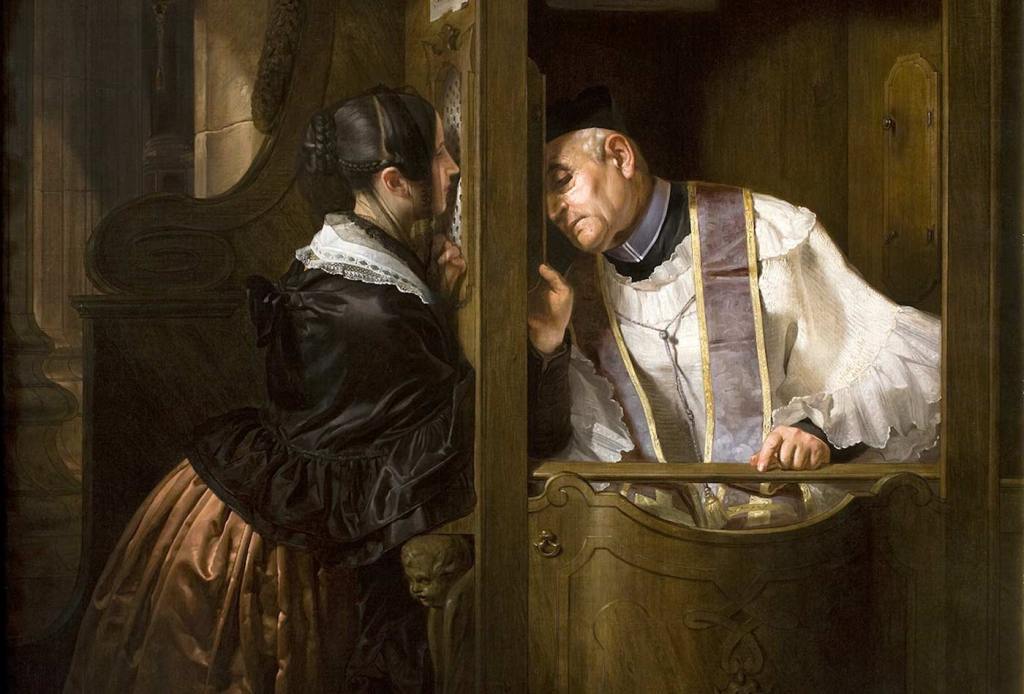
Note that “Sister Spider Demon” refused to do either of these properly, and it was because of this she lost her chance. How many of us have ever told the priest we’re not going to do our assigned penance and then expect him to grant us absolution? NONE! It is precisely the Christian message that through suffering we are purified and brought closer to God, who Himself suffered in the person of Jesus Christ! As is the case in most of the new testament, this refers to unjust suffering and affliction but it also refers to all suffering.
If Demon Slayer really takes place in our world’s Taisho era Japan, then Heaven and Hell are realties. And although we don’t necessarily have power to claim the final destination of these two souls, the evidence seems to suggest they’ll be in different places (or states if you prefer).
Mother spider demon accepts death without putting up a fight and is rewarded with a painless passing. Sister demon fights and once subdued begs for mercy only to lie and refuse the offer. She ends with what seems like a very painful death.
We must cast off our old self and die to ourself in order to gain life.
Finally a short note:
It is difficult for us humans, but it is the Catholic way to use a “Both/And” approach to many topics. There are many dangers in over emphasizing God’s Justice or His Mercy. But we know that properly seeing one gives illumination to the other. Only by fully understanding what we deserve from our sins can we rejoice in God’s mercy that much more. One example: Devotion to the Sacred Heart of Jesus which stems from His Passion and Death is inherently linked with Devotion to His Divine Mercy.
Perhaps a few parting words could be thus:
- Evil must be cut out from our lives and it can be painful most times
- Even with all our sins, God offers us His gracious gift of mercy.
- “Shall we receive good from God, and shall we not receive evil?” (Job 2:10)
- Love the Sacrament of Penance since it brings us closer to the Most Blessed Sacrament


 Anime Christi
Leave a comment